Showing posts with label hail caesar. Show all posts

Tuesday, September 27, 2016

Ebay find: 6mm Baccus Achaemenid Persian army

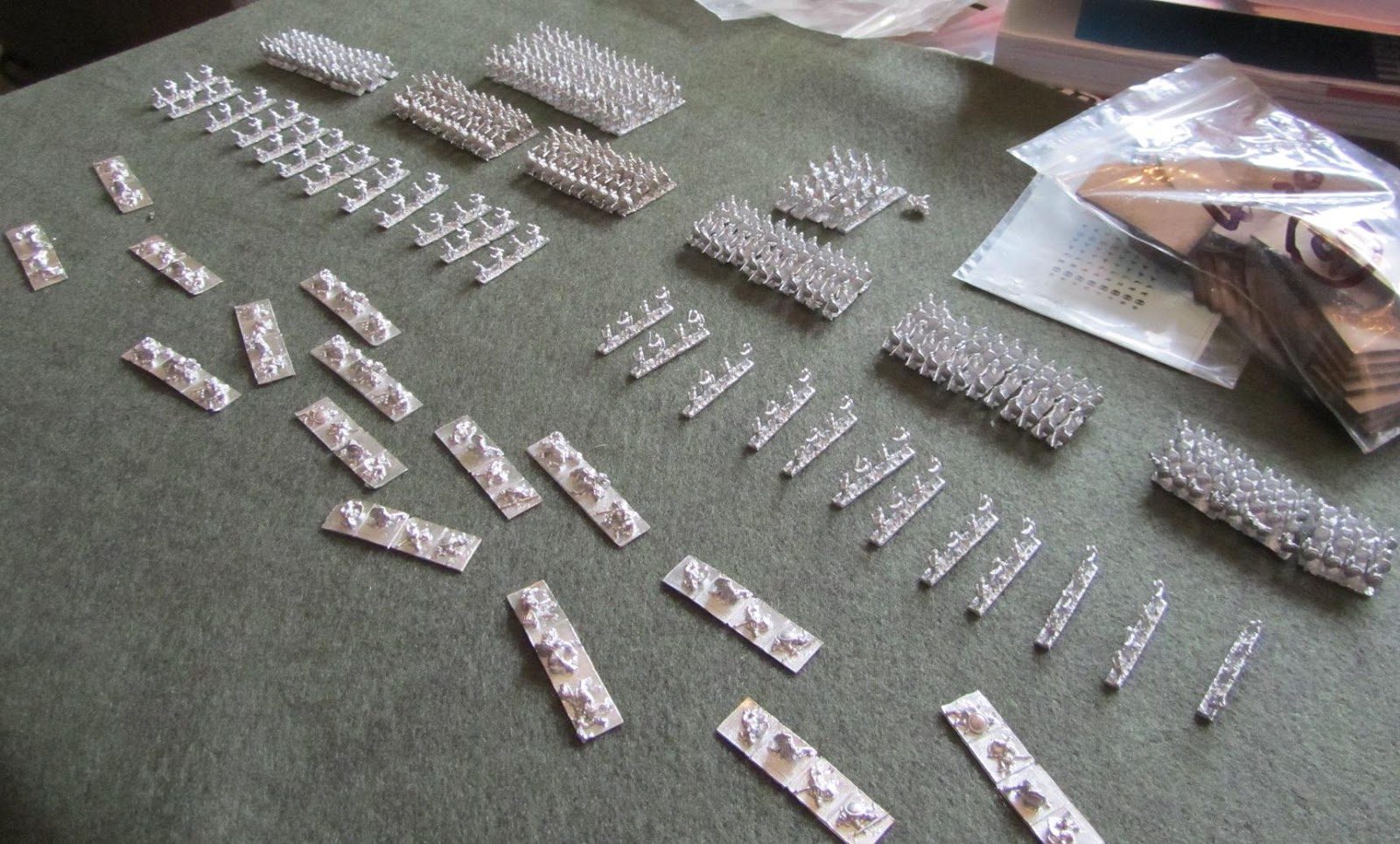
I've been meaning to get around to do Persians to oppose my Hoplite Greek army for a couple of years now, but have been kept busy by other projects. Then I noticed a Hungarian guy using the name klviktor2012 selling a fully painted Early Achaemenid Persian army that was based for Warmaster like my Greeks as well! Obviously I bid for the army and got it for a very nice price indeed. Everything went smoothly with klviktor2012 and I received the carefully packed army today. I'm really happy with these models! I now have about 1000 Warmaster points or 3-4 Hail Caesar divisions worth of troops for each army, plenty to get me some Greek & Persian Wars action!

The whole army

Closeup.


And my Greeks for comparison. The base colours differ somewhat but it only serves to distinguish between the sides.

Monday, March 31, 2014

6mm Hail Caesar: Syracuse versus early Carthage

I've been busy painting my Hoplite army and I'm now able to field a fully painted 300 point army of two divisions. I took them out to face my friends' early Carthaginians. I used the Syracusan list as they were the Hoplite army most often facing the boys from North Africa. I've embedded commentary on the game in the images in an attempt to make the action more clear. I think I should start using arrows and such more to make movement clearer..


It was a close victory for Syracuse. It's not clear if Carthage would not have won of the game would have progressed further but it seemed a bit unlikely that they would break both of the Syracusan divisions. It feels like games of Hail Caesar seem to drag on a bit after the main clash. Maybe a mod to make armies break more easily once the line is fouled up or reduce the number of divisions needed broken for the army to quit the field? The rules state that you have to have more than half of the divisions broken for the army to quit the field, but it really doesn't work with two divisions. Maybe settle for one broken division for two division games and it might look more what it's supposed to.


In other news, I got Phantom Leader, a solitaire wargame of air missions over Vietnam. It's pretty fun and definitely a challenge.

The game doesn't need a lot of space and you can put everything away between campaign missions

Here's where the magic happens. You have to choose your avenues of approach to the target and decide how to engage the enemy in the area. There's also a ground target to destroy.


Monday, August 5, 2013

A Hail Caesar division worth of Hoplite Greek done.

Here you go:


The back row hoplites are the same I showed you earlier but the "attacking" hoplites, the psiloi and the general are new. I actually did four additional stands of psiloi at the same time but it's just more of the same and they'll get their chance to have their photo taken after I finish the next batch.

For Hail Caesar, this set is enough for four standard units of hoplites, two small skirmisher units and a commander to lead them. Once I triple this I'll have quite a nice army to fight with. For Warmaster Ancients the situation is a bit worse as this is enough for just two and a half units of Hoplites and one of Skirmishers and I think I'd need 8-10 units of Hoplites at least. Anyway, it's a start.

Saturday, August 3, 2013

Two games in a week feels like luxury these days (ASL and Hail Caesar)

As the average wargamer often sports some grey hair in addition to a well earned beer belly, I suppose many of you have been where I am right now. Taking care of a small child seems to take a lot out of my hobby time budget. That's why getting to play on two days of the week when it's not a convention week seems like a rarity and a treat. On the other hand, I'm in a very nice place in my life right now as I have taken four and a half months off work to take care of my heir and give my wife a chance to return to her career a few months early. It definitely is a nice change of routine and I get to paint some figures during naptime if the house is in order (which it is not as I write this).

Now where did I put that mapboard...
The first game of this week was even more rare as I got to play a game of Advanced Squad Leader for the first time in little less than a year. ASL is one of those games that gets a pitiful amount of play compared to the amount of modules and expansions I have stockpiled. The phonebook sized rulebook just keeps scaring away any potential opponent recruits.

Anyway, we played PB4 - Killean's red from the Pegasus Bridge module. In the scenario, the Brits have taken the bridge and are sweeping a village nearby to get rid of some pesky snipers. The Germans get good sniper activation rolls but their troop quality isn't anywhere close to the British paratroopers. I'll just post a couple of pictures from the game to give anyone interested an idea on how it went.

Opening setup. The Germans have troops in two hidden hexes in addition to what you see.
After the British creep slowly forward the Germans are quick to give away their hidden troops' positions for easy shots. This enables the Brits to move with more confidence. They quickly advance and melee several German positions with success.

The British take the church held by the Germans. The sniper in the tower is taken out but the best British leader falls casualty in the effort.

The German resistance breaks and the British secure the village.

At the end there are no German troops left in the village.
The scenario went a bit too well for the British, and I checked the stats from ROAR where people can record their plays. The British have won roughly double the amount of games compared to the Germans in this scenario. It's definitely imbalanced though not impossible for the Germans. No Victoria Crosses for me for this easy win.

The second game of the week was a game of Hail Caesar. As you might have noticed I finally kicked off my Greek project. My opponent is also busy doing some Carthaginians, so I suppose we have some common ground to fight over in Sicily. We don't have that many troops completed and played just a small game with some empty stands and the few figures we had so I didn't bother with more than one photo. I used the Hoplite Greek list and my opponent used Early Carthaginian with a couple of Elephants thrown in for fun.


The match went pretty smoothly and since it's my second game of Hail Caesar, we got the rules running pretty quickly. I think the rules suit demo gaming pretty well as they seemed quite easy to teach, especially to someone familiar with Warhammer Fantasy.

The dynamics and the pacing of the game oddly enough remind me of Commands&Colors. It is improbable that a divisional commander is able to activate all his troops in a single turn and the turn might sometimes pass without the division doing anything. This leads to the situation where the general must prioritize which units he wants to move and try to keep a coherent line going knowing he'll probably fail a command check before everyone moves. This reminds me of C&C in the way that the battle sometimes develops quickly on one section of the field and remains static in another. The player can take care to try and even out the successful activations in the line but this can lead to losing the initiative in another portion of the field. The Move/Countermove dynamic of C&C seems to be present here. It will definitely drive players used to having full control nuts. For me, it's ok. I just have to adjust my tactics accordingly.

In the match, the superiority of the Hoplite heavy infantry versus the African medium infantry was clear. For our next match I think I'll switch to the proper Syracusan list to even things out a bit. That list has worse hoplites and a chance to field some barbarian mercenaries. Don't be fooled into thinking the Hail Caesar lists are balanced for competitive play as they are not. You need to work together with your opponents to get enjoyable games.

Wednesday, April 18, 2012

New Baccus Greeks arrive

I finally got around to ordering those sweet new Baccus 6mm ancient Greeks I've been wanting. I bought 53 british pounds worth of figures, a sheet of shield transfers (barely enough for front rankers) and a bag of MDF bases. I got some hoplites, archers, peltasts, cavalry, generals and casualty figures.


The set was missing two strips of hoplite infantry and one general was broken. I sent e-mail to Baccus about it and got a reply not 10 minutes later from Peter Berry stating he'll send me replacements. Now that's customer service! It's just a pity to post mail from Britain to Finland just to deliver less than ten 6mm figures.


The figures look really nice, some of Baccus' best yet. The "attacking hoplites" with their dynamic looking formation are my favourite. As a downside, the spears look dreadfully thin and seem like they will break easily, but if I can keep them intact until painted and based, I think it'll be fine.


My plan was to use the figures with the Hail Caesar rules. I plan to just convert the inches of Hail Caesar to centimeters 1:1, so that a large 28mm game becomes a 6mm game on a small table. My plan initially was to make 6cm * 3cm blocks the size of the standard unit, but after heeding the advice of fellow gamers, I decided I would make the basing compatible with Warmaster Ancients also. This means the default block of 6*3 centimeters will give way to 2*4 centimeters. Here's what a phalanx formation will look like based with Warmaster standards:


I think it looks good and by making the standard unit 8 centimeters wide instead of 6, it looks much bigger. The bases are used with their short edge to the front by only a couple of units in Warmaster, including phalanxes. By using two stands side by side you get something like this with two or three ranks of figures: 


I think it will look quite nice. I'll have to do some more testing and deliberation, but I'm pretty sure this is the way to go.

By the way, my last post on ancient greek warfare spawned some interesting visit hits on this blog. To be precise, keywords such as "naked greek guys" have now been used to visit. Truly, my blog caters to all, even though I'm not sure the person tapping in those keywords was looking for wargaming stuff.

EDIT: Oh, nuts. Greek hoplites are not rated as Phalanxes in Warmaster, and as such, should be based with the normal sideways base. I'm pretty sure the "attacking" hoplite strips will not fit on the stands as such. More deliberation is needed (and hints appreciated).

Friday, January 20, 2012

Converting Hail caesar for 6mm, first playtest session

I got Hail Caesar on the table today together with one of my regular opponents. I have been toying with the idea of starting a new period, and with the release of Hail Caesar by Rick Priestley and the release of new Greek sculpts by Baccus, I'm tempted to do a hoplite greek set.

Shining bronze, detailed shields and naked greek men. What's not to like?

There are some considerations before I pull out my Visa. First, will Hail Caesar work with 6mm miniatures, and what basing would work well? Second, is the game better than say, Warmaster ancients? Well, I've only skimmed the rules of Warmaster and never played it, but since both games are Priestley's work, it's a good base assumption that the new game is more refined than the old. Do I hear the cries of "Cult of the new!" over the horizon? Maybe it was just the wind.

Hail Caesar is primarily designed to be played with 28mm miniatures on a table which allows a 36" space between the opposing lines at the start of the battle. I wanted to try out one of the example scenarios in the rulebook, but there were no guidelines in the book on what size the tables are in the scenarios. Now, Priestley states many times in the book that players are free to tailor everything to their needs (as if we needed permission) but I think in published scenarios it is nice to know the relative distances between the forces as this impacts scenario balance. I asked about it on the Warlord Games forum and got a reply from Priestley himself:

Most of the games were played on Alan or Michael Perry's wargames table - both six feet wide and usually ten or twelve feet long depending on how its set up.

The Sassanid game and the Roman/Celt game were played on John Stallard's table - which is more like five feet by ten if I remember right - it does depend on how things are set up. The Roman/Celt game was re-photographed after the event - the Sassanid game was photographed as we played.

Three feet apart is good for a very standard type of 'line em up' style game - basically both sides deploying within six inches of the table edge of a four foot wide table. That's a realistic table size of most people I think (including me!). The games in the book are all much more narrative apart from the Sassanid game - which is fairly close to a line 'em up game - so the sides start off often much further apart. Three feet puts both armies out of 3 moves at the start of the game - which is what I'd aim for.

Rick

Now, 6 feet is a pretty deep table, 182,88 centimeters to be precise. It's possible to have a table that big in your average home but it will be difficult to set up a game and have enough terrain on it to keep it attractive. Here's where the 6mm scale shines. Baccus miniatures are designed to look best on a unit stand with a 60 millimeter frontage. The frontage of your average 28mm Hail Caesar unit is stated to be somewhere around  160-200 millimeters, that is eight to ten infantry wide, if they're based individually on 20mm bases. Suppose I just shrink the game so that each inch from the rulebook counts as a centimeter? This means that the 6 foot deep table would now be only 72 centimeters deep. That's almost a DBA sized table! This means I have to shrink the units as well. A Baccus infantry stand 60 centimeters wide would with this scale be the same as a 152,4 millimeter wide unit on a "big table". Close enough for me, and I'm sure it works gameplay-wise as I'll probably end up doing all the armies for this set anyway. The depth of the units is not an issue according to the author, anything that looks appropriate should work. I think for depth I'll stick with the 1:2 ratio to the frontage, as this would allow the stands to be used in a variety of games.

I deemed it necessary to play a test game or two with the rules before committing any money to figures, so I made some print & play units for hoplites, light infantry in open order and cavalry.


Here's an example of the units I made. I drew them on a computer, printed them out and glued them on cardstock. The hoplite units are, at the moment divided into two blocks, as it allows me to use the different formations in the game without resorting to markers. There's a small light infantry unit which I though should at most be half as deep as a hoplite formation. Then there's a small light cavalry unit. The "figures" should have a footprint more or less equal to what the corresponding 6mm figures would have. 

The example scenario we played was a small two division versus two division fictional battle set in the Peloponnesian war. The Spartans and their allies are attacking a road held by the Athenians and their allies. A simple line battle with no special twists. There was an ambush rule in the original scenario, but that would have been difficult to do without an umpire so I didn't include it.

The opposing forces meet. The many dice near the units are for keeping track of casualties as you don't remove figures from the units in a game of Hail Caesar. Another thing in favor of 6mm armies, but it does give the game a cluttered look until I get some casualty tokens.
The game was straightforward. The Spartans advanced on the Athenians. The Athenians, being more numerous, attempted to flank the Spartans with poor success. Battle was joined, casualties suffered, and the Spartan elite hoplite phalanx was left king of the hill, being the only unit not shaken at the end.

This was a learning game so we got some rules wrong which were possibly game impacting ones. That didn't matter as we had a fun evening even with these small forces. It took us around three hours to play the scenario and after learning the rules, I think this'll finish in less than two. The 6mm basing worked well for the hoplites and cavalry, but I still have to think about the basing of light infantry. They can change between open order and formed quite easily and making open order visually obvious gives me some thought. Should I have one or two of those small rectangles with figures in scattered formation or put them on a circular stand? With a circular stand the open order formation is immediately obvious, but it might be difficult to position the troops in some situations, and you can't have a long string of skirmishers when they're in one "horde". In the very least, I might end up doing separate versions for light infantry in formed and open order mode as it won't be much trouble. 

Every Phalanx shaken except the Spartan one. No, I don't want to hear the catchphrase.
I can't give much insight on the rules before I play a couple more games. It's obvious however that veterans of Warhammer and Warmaster should feel right at home in this one. The terms are different but the rule mechanics are very familiar. Especially the different special rules which you can give units had a very Warhammer-y feel to them. The biggest departure is probably that you don't need to pay wheeling costs for units. You just move into the direction you want and pivot the unit to the facing of you desire when you finish. If you move within 12" (or 12 cm in my case) of an enemy, you have to face that enemy and can only move towards or away from that enemy as long as you are within 12". If you announce a charge, you have to move into contact by the most direct route, eliminating the chance of overly agile flank charges. It seems to work fine, but I'm not yet sure if hoplite warfare has the right "feel" with these rules, or if they're more at home in the dark ages.

Ok, if you actually read this far, you're a better man than I and deserve a rest. I'll continue on the subject on a later date as my plan evolves.