Showing posts with label napoleonic. Show all posts

Sunday, January 24, 2021

2020 stragglers finished

Here's some models I've finished after christmas. Now my table is empty of half-painted figures and I can start on new stuff!

Heinrich Kemmler and Krell
 
Some test Russians for my Finnish War 1808 28mm project

Nazgob the shaman. This had been on my desk for a long time!


The remaining members of the Fellowship of the Ring. Now I have the full set.


Cue the Howard Shore "Fellowship of the Ring fanfare"


Wednesday, September 6, 2017

Battle of Siikajoki 18.4.1808

Historical Background:

The Finnish army had been in a planned retreat for nearly two months since the start of the Finnish war. Several small engagements had been fought between the Finns and the Russians, including the battles of Leppävirta and Virre, in order to slow down the Russians and buy the army time. Now, the scattered Finnish army began to converge near the town of Oulu and the main army was no longer under the threat of being cut off by the Russian fifth division advancing through Savonia. The Russian supply lines were stretched out and spring was approaching. Soon, the ice covering the Gulf of Finland would melt and the Swedish navy would be able to break the siege at Viapori, the invincible bastion built on the islands near Helsinki. The situation was looking up for Sweden, but high commander Klingspor was still cautious and willing to pull the army back further north towards Tornio.

Adlercreutz at Siikajoki (Albert Edelfeldt, 1897-1900)

The army retreated again but hot on its heels, the tenacious cavalry commander Kulnev posed a serious threat to the Finnish baggage train. Von Döbeln and his Pori (Björneborg) infantry regiment took up position at the southern side of river Siikajoki to allow the baggage train to cross. The third brigade, led by Gripenberg and consisting of the Häme (Tavastehus) infantry who fought at Viirre, would cover Von Döbeln's retreat to the northern bank of the river. Then, Kulnev attacked the Finnish rearguard.


The Historical Battle:


Von Döbeln fought an exemplary rearguard action, stalling Kulnev's forces and feeding his men into the line sparingly. Kulnev sent a detachment of cavalry under the command of major Silin to flank the Finns via the frozen sea. Döbeln held his position near Siikajoki church until half past five in the afternoon. At this point his troops were wavering and he received orders to pull back on the northern side of the river. This was the moment Silin had been waiting for and he attacked with his cavalry. Adlercreutz sent reinforcements to counter the cavalry but nevertheless they struck a weak point in the Finnish positions, at one point threatening to overrun the Finnish command post with Klingspor himself there! The dragoons of Uusimaa drove away Silin's cossacks but Klingspor prudently relocated his command post from Pietola farm towards Liminka, ordering Adlercreutz to withdraw from the field.

The Russians took the southern bank of the river after Von Döbeln withdrew and artillery on both sides began to exchange fire. The Russians made a weak attempt to cross the river but were repulsed by the Finns who were preparing to pull back from the battle. At this point, Adlercreutz marked that the Russian army was spread out too thinly. Acting against his orders, Adlercreutz ordered elements from Gripenberg's third brigade to assault and retake the Siikajoki church. This was achieved by a bayonet charge as darkness fell over the snowy landscape. The Russians withdrew from the field but it was too late in the day for Adlercreutz to pursue.

The battle of Siikajoki was the first proper Swedish victory in the war, but Klingspor did not take advantage of it, ordering his army to withdraw from the field and resume marching north. Still, it was a vital morale boost for the army and a very auspicious beginning for the pushback that was to come.


The refight:

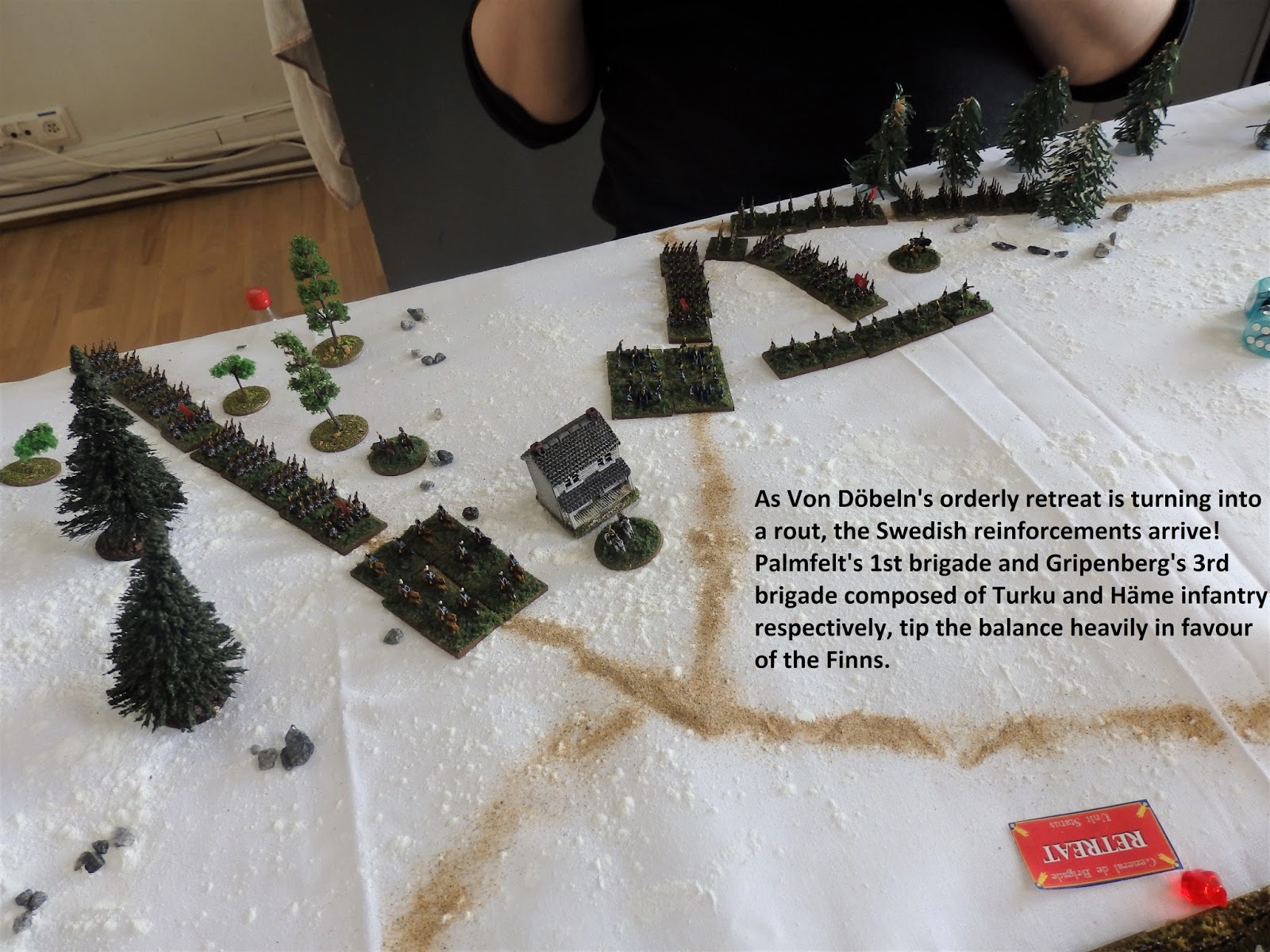
We fought the battle using Heroics and Ros 6mm and General De Brigade 2nd edition rules. The goal of the Russians is to push back the Swedish defenders from the southern bank of the river, cross over if possible and hold position if not possible. The Swedes should stall the Russian advance until reinforcements arrive and retreat in an orderly fashion without heavy losses. Note that we accidentally reversed Kulnev's and Turtschaninov's positions in our game. Commentary embedded in the images.


Wounded warrior on the snow (Helene Schjerfbeck, 1880)

The game took 21 turns and the entire day to play. It was a long scenario starting with the Russian attack after which the Finns got their chance to counterattack. This made for a varied scenario even if it took a long time to play. The game went pretty much according to history up until the counterattack of the Swedish army. That attack went terribly wrong and the Finns, who had been taking a lot more punishment than the Russians throughout the game, ended up losing almost triple the number of men than the Swedes. Losses-wise the battle was also much bloodier than the real thing (again, usual in wargames). The "figure losses" in GdB were 81 lost by the Finns against just 29 lost by the Russians. As one figure equals 20 men, that's bloody for this small war. I'll have to say this result didn't owe as much to my tactical brilliance as Kulnev as it did to my excellent dice rolling!

In the end we ruled that the end result would still be the same: The Russians would have to retreat as they couldn't possibly hold the field, but the Finns' morale and fighting capabilities would be hurt in the grand scheme of things.


Battlefield visit:

While going to my friends' wedding in Oulu this spring, I made a detour to Siikajoki with my wife onboard (bless her). The battlefield hasn't seen much development and all the fields, woods and roads are pretty much where they were two hundred years ago. The church is the same one too. As usual, it's very interesting to visit the battle site you wargame and to be able to see the distances in proper 1:1 scale. I think we did ok in our wargame. The only differences are that the terrain was pretty much totally flat aside from the banks of the river and the river itself was perhaps a bit too wide considering the groundscale of our wargame.


The first thing I noticed is that the Siikajoki church, depicted as being on a hill on the maps, isn't on a hill.

View to the east from the church. The field and the woods beyond are pretty much as they were back in 1808.

The woods south of the church. Here the Pori infantry skirmished against the Russians. You can imagine the benefits of maintaining a loose formation, especially in deep snow.

The church is still the same building as it was 200 years ago.
Behind the church lies the river. The banks of the river are steep and worthy of a good "defended obstacle" modifier. It's hard to see the river from the trees. I wonder if the backs were this wooded in 1808..
A better shot of the river a few kilometers upstream. It's wide and shallow, but perhaps not as wide as we made it out to be in our scenario.
"For the soldiers who fell in the battle of Siikajoki 1808"

Wednesday, July 6, 2016

Russo-Swedish War 1808: Battle of Leppävirta re-refight

The custom table I built for the Leppävirta game we played last summer was still intact in my workshop (check it out if you want to make any sense of this game) so we took it for another spin. We used General de Brigade rules again but changed the scenario a bit. Instead of the troops being deployed historically at the beginning of the scenario we recorded their marching order on paper and had them march on the table and essentially bump into each other. Having a meeting engagement this close to each other is a stretch of imagination as both sides have plenty of dragoons to give advance warning that the enemy is near, but it makes for a fun scenario.

The frozen lake near Leppävirta sees battle once more! Dragoons on both sides have deployed to screen the marching columns but it will be a hasty deployment for the rest.
The Savolax brigade has put it's artillery to the front of the column. It's risky but will prove important.
The Russians have an equivalent number of troops. Their artillery is at the back.
The Savonian artillery deploys quickly and opens fire on the Russian cavalry.
Savonian Jägers move to the right flank and skirmish with their Russian counterparts.
Cossacks more around the Savonian left. Any baggage in the rear is in serious trouble!
The Savonians have managed to deploy more quickly and achieve local superiority in firepower on their right. Artillery, infantry and jägers make it hard for the Russians to form up for their attack.
The Russians attempt an attack on the Savonian line but face too much fire so they retreat. The Savonians swing around the right, routing the Russian jägers in the forest and now threaten the Russian artillery which hasn't been able to deploy effectively. We call the game at this point as the Savonians have suffered only minor casualties.
The jägers push towards the Russian battery

The game was pretty much decided by the artillery. The Savonian artillery was on the front of the column and was able to deploy quickly and start firing right away. The infantry then moved to protect the battery while the dragoons screened the manoeuver. The Russian artillery was at the rear and wasn't able to deploy with a good line of fire during the whole game. The rest was simple math as the deployed battery gave the Savolax brigade more firepower. The Savonians could just wait and keep up their fire as the Russians were forced to charge as they couldn't match the Savonians at long range. It didn't end up well for the Russians.

I'm not sure if putting the artillery up front was gamey and unhistorical of me, but it proved decisive!

Friday, February 13, 2015

Some Blood Bowl and Block War

Quiet on the Hobby front. I haven't been finishing many models lately, although I did do some 20mm scale telegraph poles for WW2 I might post later,b ut I did get a couple of games in. Nothing much to report but here's a couple of pics.

Blood Bowl:

I'm shocked to find out that I haven't played a single game of Blood Bowl on the table during the existence of this blog! I have played the computer version(s) during this time but not a single game on the board for years even though I love the game to bits! This will not stand! I dusted off my goblins last weekend (I also have an orc and an undead team) and played against my friends' Ogres. I lost 1-0 after a lengthy grind, but it was fun. I actually noticed I had forgotten quite a few core rules during these years of downtime even though I have scores of games under my belt. I hope to reignite the game in my local group now to get people playing again.

My custom Blood Bowl board transforms into a carrying case to put my figures, papers and dice in.

The Goblins try to catch the snotlings while the Trolls grapple with the Ogres.

This one doesn't like being filmed.

Excuse me..


Napoléon (Columbia Games):

You know I love block wargaming and Columbia's offers are always a treat. I've played an older edition of Napoléon before and got a chance to play the fresh Kickstarter funded edition now. I don't remember much about the first time I played but my opponent says the changes to the new edition are minor. The game details the Waterloo campaign and I played the French. I tried to focus on the Brits first to defeat the Coalition one army at at time, but it didn't work out so well. Napoleon did beat Wellington and force the British to surrender, but the French didn't have the time or the fight in them to stand against Blucher after that


In other news, I've fixed my old Amiga 500 and replaced the old disk drive with a floppy emulator so that I can now load games onto the Amiga from a USB stick. All it took was a firmware flash to a generic industrial pc floppy emulator! Pretty neat, huh?


Tuesday, October 8, 2013

Warcon 2013

This year's Warcon (held in Tampere, Finland) was a treat as always. I managed to keep playing through the weekend with only minimal downtime and tried quite a few new wargames.

Sword of Rome

Sword of Rome is GMT's card driven strategy boardgame set in the Camillan period of Rome (I think). It puts the Romans, Gauls, Phoenicians, Samnites, Syracusans and Carthaginians on the board to solve their disputes with some dice rolling and maneouvering.

We played a four player game. I got the Gauls.

After some successful campaigning (looting the countryside that is) the Gauls threaten Rome herself. Brennus besieges Rome but is unable to make her surrender.
I neglect to protect my rear and the transalpine Gauls invade. The support of my home cities crumble and disaster is near.
With sage advice from an experienced player, I stab the Phoenicians in the back, claiming enough victories to resume control of my home territories.

In the end, the Phoenicians were totally wiped out and Rome was barely hanging on. After learning a valuable lesson on protecting my rear, I went on to grab a tiebreaker victory from the Greeks.


 Commands & Colors: Napoleonics

A quick filler game of C&C:N to finish friday. I don't remember the scenario but my brits and portuguese troops were soundly beaten.


Labyrinth: The War on Terror 2001 - ?

GMT's Successor to Twilight Struggle, Labyrinth is a card driven game where the United States attempts to stem the rising Islamist extremism in the Middle East and Europe.
I was a first timer playing versus someone who had played the game some times before, so I picked US because I thought it would be easier to play for the first time.

My opponent's opening play was to dump all terrorist cells in Afghanistan on the first round. He explained to me that the move was pretty much the best one could do in the game at this point. I responded by putting some boots on the ground and by overthrowing the Islamist regime.
My opponent then spread his cells to the neighboring Pakistan managing to overthrown the local government. I retaliated again by sending troops, but unfortunately not before the Islamists had helped themselves to the Pakistani nuclear arsenal!
The results were predictable. With a few moves I was unable to stop he moved his terrorist cells through Europe to the United States and blew up a nuke there. Game Over.
The game felt somewhat confusing and after the brief game I still don't have an idea on how to play or stop the terrorist infiltrators. I think I'll need a game or two more to wrap my head around the game.


Maria

Maria is Histogame's game set in the Austrian War of Succession in the 1700's. It is the successor of Friedrich and I have played it a few times now. It is one of the better three player wargames out there but not exactly balanced. Prussia wins often, France sometimes and Austria rarely. I was teaching the game to two new players so I naturally picked Austria.

After a traditional slugfest between Austria and France, the Austrians are left with little to pit against Frederick the Great.
The surprise comes from the French front, however as the Pragmatic army defeats the French and bring the game to a conclusion before the Prussians get a chance. This I've never seen before (although both Prussia and the Pragmatics are played by the same player)


Black Powder ACW

My first game of Black Powder and for me the main event of Warcon. We played the battle for the Wheatfield (Gettysburg) on a regimental level and fun was had by all. I'll write up a dedicated post on the game itself as it deserves it's own entry.


Epic Armageddon

My return to the grim darkness of the 41st millenium is in 6mm. A fellow gamer who has participated in some of my ACW games was happy to show me the ropes.

The Dark Angels and the Tyranids fight over a city on a not so grim and dark green planet.
The Marines capture a block while the Tyranids quicly capture most of the city.
*Scuttle Scuttle*
The buildings provide a good firebase

The tyranids charge the marine positions and reach melee range but are ultimately driven back.

The Marines take the city.

My opponent had put a bit more effort in his models than I had.


The game felt good and I decided then and there to expand my marines to a proper tournament sized army. I'm sure my opponent pulled some of his punches to spare the newbie so the next game won't be quite as easy.


Pax Baltica

I was interested to try this out. Another GMT game, Pax Baltica is a block wargame where two players play through the twilight era of Sweden as a great world power.

On the first turn the Swedes invade Estonia. This proves to be a mistake as the Russians are in range to counterattack and drinve them back into the sea.

Swedish armies are quick to raise but it takes time to get them across the Baltic sea. All invasion attempts are blocked.

The Russians can now spare some troops and invade my real life hometown in Finland.

The Swedish wise up and attempt a new invasion into the German territories, but Saxony has already gained too much strength and are more than a match for the Swedes.

The final battle ends with the Swedish king left alone on the field with one point as the attackers are forced to retreat. We call it a game at this point.

Either my opponent should have made a different opening play, we played the rules wrong or the rules are broken because it was next to impossible for the Swedes to gain a beachhead in the Baltics or in Germany. It's a fresh scenario though, not many GNW games around.


Commands & Colors: Ancients

I had just enough time left on Sunday to play a game of C&C:A. We played the battle of Marathon from the Greek expansion.

Opening setup. I got to play the Greeks.

With two consecutive "Order line" commands, I made simultaneous contact to the Persian line with all my troops.

The Persians line falters.

I add insult to injury with a card that allows me to hit with every unit adjacent to the enemy.

The Persian made a good comeback and only lost 6-5.

So, there it was, another thoroughly enjoyable con with lots of games to play. I'll end with some snaps from games I did not participate in.

Space Empires 4X
Red Winter
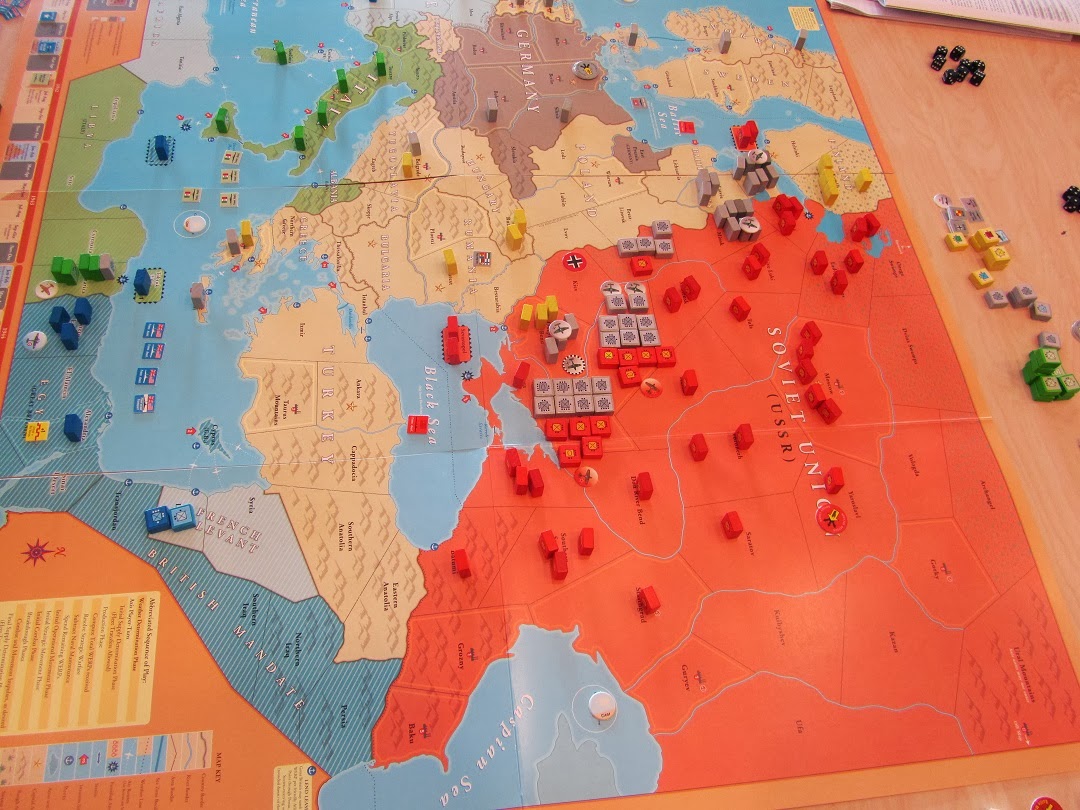
Europe Engulfed
Veli Veljeä Vastaan, a prototype wargame of the Finnish Civil War.
Manoeuvre.
Europe Engulfed, some 11 hours later.
Sword of Rome was really popular this year.
Nuklear Winter something something.