Showing posts with label battlefield visit. Show all posts

Saturday, September 8, 2018

The swedes stage a false flag attack against Russia!

Ok, that was clickbait. This news is 230 years old, but it makes for an interesting and largely forgotten story.

In the 1780's, Gustav III of Sweden wasn't happy. His ancestors were great warrior kings and he wanted to be one too, but the geopolitical position of Sweden did not offer any good opportunities for a would-be lion of the North. The days of Sweden being a European great power had been numbered since Poltava. He needed a good war but Swedish law did not allow the king to declare an offensive war by himself. His cousin, Catherine the Great of Russia was busy fighting a war against the Turks. Maaaybe there would be a chance to capitalize on that. He just needed a casus belli. A great lover of the theater, Gustav hatched a plan..

It is not conclusively proven that the incident at Vuolteensalmi strait near Puumala was staged, but there is plenty of evidence to suggest it was. In the spring of 1788, the King was already making plans for an offensive war and making secret preparations. He had also commissioned some Russian uniforms to be made and held talks with the commander of the Savolax Brigade. In June, there were reports of Russian troops violating the border near Vuolteensalmi and some men of the Savonian infantry regiment were sent to investigate. At Vuolteensalmi strait they encountered what seemed to be a Russian force, and a firefight at a distance ensued. After an hour or so, the encounter ended. The Savonians reported having shot only twice and the Russians had failed to kill or wound anyone. Enraged, the king declared war on the aggressors and he had a legal right to do so as this was obviously a defensive war!

The summer cabin of my wifes' family is in Puumala, only ten kilometers from Vuolteensalmi so I took my family there today under the pretense of picking some mushrooms in the forest.

The strait on a period map. The strait is narrow and shallow and there was a small bridge across.
The bridge is long gone and the road hasn't been used for a long time.
The foundations of the road can still be seen. The Savonian infantry took cover in the woods on this side from the "Russians" firing at them from the other side.
The strait would have been easily fordable this time of year.

No monuments or plaques for this historical event.
Sweden went into war ill-prepared and Russia wasn't as distracted by the Turks as the king had hoped. If cousin Gustaf wanted a fight, Catherine was happy to oblige. By summers end, the Swedes and Finns were on the defensive and the Finnish officers who had seen through Gustaf's ruse were plotting to mutiny because of the unjust war. The situation would only get worse in 1789 and only the victory at the Battle of Svensksund in 1790 would scrape up enough "war score" for Gustaf so that he could sue for peace. Gustav ended up being assassinated by his own nobility that same year.

Also, we found some mushrooms on the site, too!

Wednesday, September 6, 2017

Battle of Siikajoki 18.4.1808

Historical Background:

The Finnish army had been in a planned retreat for nearly two months since the start of the Finnish war. Several small engagements had been fought between the Finns and the Russians, including the battles of Leppävirta and Virre, in order to slow down the Russians and buy the army time. Now, the scattered Finnish army began to converge near the town of Oulu and the main army was no longer under the threat of being cut off by the Russian fifth division advancing through Savonia. The Russian supply lines were stretched out and spring was approaching. Soon, the ice covering the Gulf of Finland would melt and the Swedish navy would be able to break the siege at Viapori, the invincible bastion built on the islands near Helsinki. The situation was looking up for Sweden, but high commander Klingspor was still cautious and willing to pull the army back further north towards Tornio.

Adlercreutz at Siikajoki (Albert Edelfeldt, 1897-1900)

The army retreated again but hot on its heels, the tenacious cavalry commander Kulnev posed a serious threat to the Finnish baggage train. Von Döbeln and his Pori (Björneborg) infantry regiment took up position at the southern side of river Siikajoki to allow the baggage train to cross. The third brigade, led by Gripenberg and consisting of the Häme (Tavastehus) infantry who fought at Viirre, would cover Von Döbeln's retreat to the northern bank of the river. Then, Kulnev attacked the Finnish rearguard.


The Historical Battle:


Von Döbeln fought an exemplary rearguard action, stalling Kulnev's forces and feeding his men into the line sparingly. Kulnev sent a detachment of cavalry under the command of major Silin to flank the Finns via the frozen sea. Döbeln held his position near Siikajoki church until half past five in the afternoon. At this point his troops were wavering and he received orders to pull back on the northern side of the river. This was the moment Silin had been waiting for and he attacked with his cavalry. Adlercreutz sent reinforcements to counter the cavalry but nevertheless they struck a weak point in the Finnish positions, at one point threatening to overrun the Finnish command post with Klingspor himself there! The dragoons of Uusimaa drove away Silin's cossacks but Klingspor prudently relocated his command post from Pietola farm towards Liminka, ordering Adlercreutz to withdraw from the field.

The Russians took the southern bank of the river after Von Döbeln withdrew and artillery on both sides began to exchange fire. The Russians made a weak attempt to cross the river but were repulsed by the Finns who were preparing to pull back from the battle. At this point, Adlercreutz marked that the Russian army was spread out too thinly. Acting against his orders, Adlercreutz ordered elements from Gripenberg's third brigade to assault and retake the Siikajoki church. This was achieved by a bayonet charge as darkness fell over the snowy landscape. The Russians withdrew from the field but it was too late in the day for Adlercreutz to pursue.

The battle of Siikajoki was the first proper Swedish victory in the war, but Klingspor did not take advantage of it, ordering his army to withdraw from the field and resume marching north. Still, it was a vital morale boost for the army and a very auspicious beginning for the pushback that was to come.


The refight:

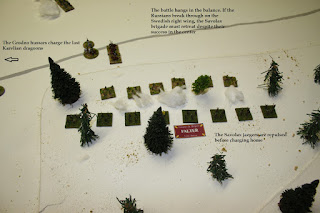
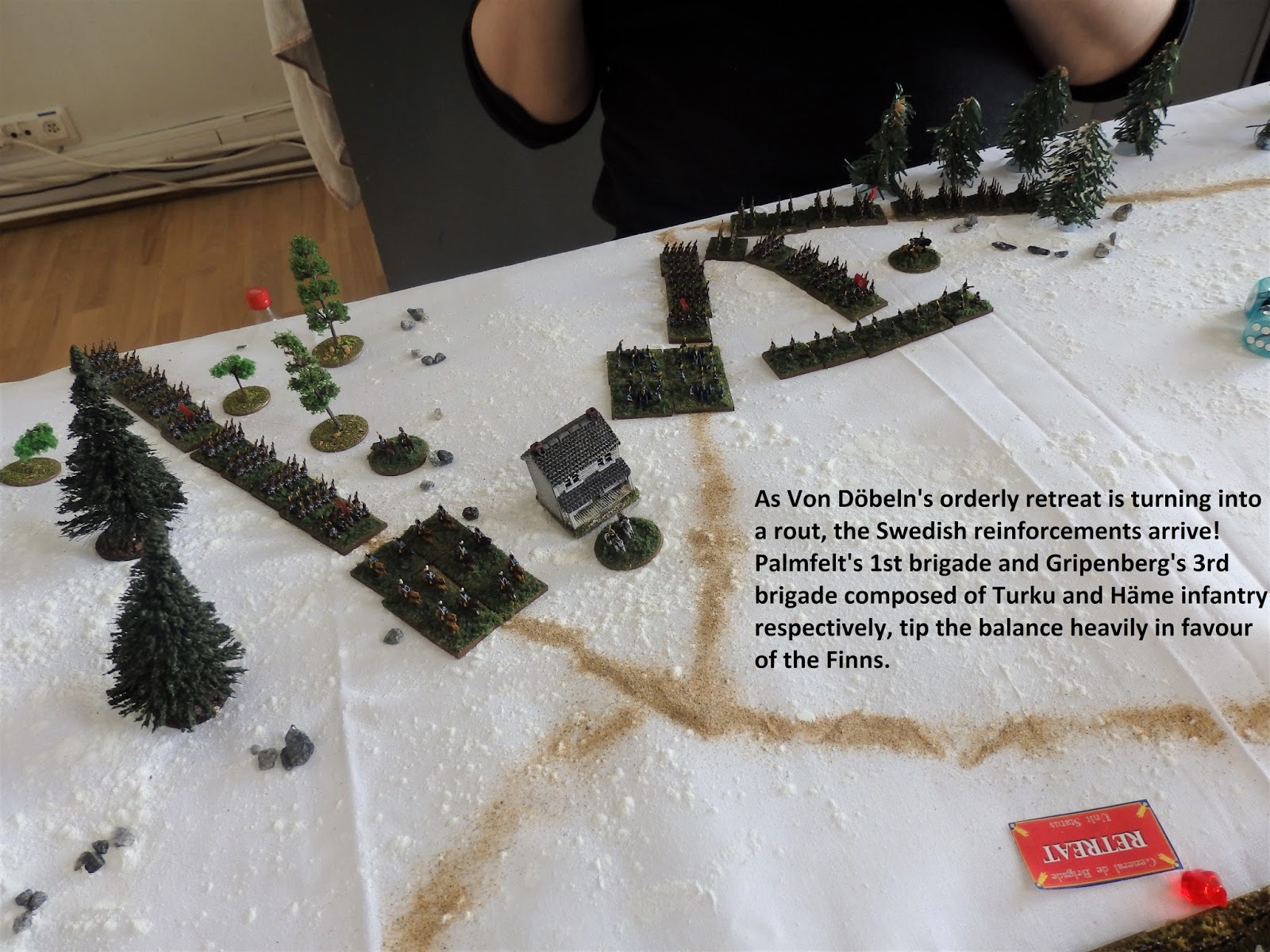
We fought the battle using Heroics and Ros 6mm and General De Brigade 2nd edition rules. The goal of the Russians is to push back the Swedish defenders from the southern bank of the river, cross over if possible and hold position if not possible. The Swedes should stall the Russian advance until reinforcements arrive and retreat in an orderly fashion without heavy losses. Note that we accidentally reversed Kulnev's and Turtschaninov's positions in our game. Commentary embedded in the images.


Wounded warrior on the snow (Helene Schjerfbeck, 1880)

The game took 21 turns and the entire day to play. It was a long scenario starting with the Russian attack after which the Finns got their chance to counterattack. This made for a varied scenario even if it took a long time to play. The game went pretty much according to history up until the counterattack of the Swedish army. That attack went terribly wrong and the Finns, who had been taking a lot more punishment than the Russians throughout the game, ended up losing almost triple the number of men than the Swedes. Losses-wise the battle was also much bloodier than the real thing (again, usual in wargames). The "figure losses" in GdB were 81 lost by the Finns against just 29 lost by the Russians. As one figure equals 20 men, that's bloody for this small war. I'll have to say this result didn't owe as much to my tactical brilliance as Kulnev as it did to my excellent dice rolling!

In the end we ruled that the end result would still be the same: The Russians would have to retreat as they couldn't possibly hold the field, but the Finns' morale and fighting capabilities would be hurt in the grand scheme of things.


Battlefield visit:

While going to my friends' wedding in Oulu this spring, I made a detour to Siikajoki with my wife onboard (bless her). The battlefield hasn't seen much development and all the fields, woods and roads are pretty much where they were two hundred years ago. The church is the same one too. As usual, it's very interesting to visit the battle site you wargame and to be able to see the distances in proper 1:1 scale. I think we did ok in our wargame. The only differences are that the terrain was pretty much totally flat aside from the banks of the river and the river itself was perhaps a bit too wide considering the groundscale of our wargame.


The first thing I noticed is that the Siikajoki church, depicted as being on a hill on the maps, isn't on a hill.

View to the east from the church. The field and the woods beyond are pretty much as they were back in 1808.

The woods south of the church. Here the Pori infantry skirmished against the Russians. You can imagine the benefits of maintaining a loose formation, especially in deep snow.

The church is still the same building as it was 200 years ago.
Behind the church lies the river. The banks of the river are steep and worthy of a good "defended obstacle" modifier. It's hard to see the river from the trees. I wonder if the backs were this wooded in 1808..
A better shot of the river a few kilometers upstream. It's wide and shallow, but perhaps not as wide as we made it out to be in our scenario.
"For the soldiers who fell in the battle of Siikajoki 1808"

Friday, July 24, 2015

Battle of Leppävirta 11.march 1808

  The Russians crossed the eastern border of the Kingdom of Sweden on the 21st of February, 1808. The winter was harsh and attacking in the winter was quite unorthodox, but this gave the Russians two advantages. Firstly, the Swedes were denied quick reinforcements because the sea was frozen and any supporting troops would have to march into Finland by land. This would make it easier to capture the strategic fortress of Viapori. Secondly, the winter conditions would actually make it easier to move armies in eastern Finland (Savolax region). The road network there was really poor, but during the winter roads were maintained on the ice of the extensive network of lakes in the region, and these were much easier to march on.

Johan Adam Cronstedt
The Russians were in Savolax in no time, and threatened the base of the Savolax brigade stationed in Mikkeli. Johan Adam Cronstedt, the commander of the brigade had had sufficient time to muster his forces. He had about 3500 men at his disposal and faced Tutskov who had roughly twice as many. Cronstedt couldn't cover all the Russian roads leading to Savolax from Mikkeli and decided to retreat. Meanwhile the main army in western Finland was also retreating before the Russian army as there was a great danger of having their supply lines cut if Cronstedt couldn't hold back the Russians. It was decided that the whole army would retreat to Oulu and wait for reinforcements, leaving Finland in Russian hands in the meanwhile.

The map of the battle.
On March 11th, the Savolax Brigade was caught by the Russian vanguard at Leppävirta and the brigade was forced to deploy on the ice of the Unnukka bay close to Leppävirta. The Russians advanced boldly with 1600 men on the ice which lead them to a difficult situation as the Swedish jaegers held the shores of the bay, threatening Russian flanks. The Russian vanguard was outnumbered and the Swedish held a good position, but Cronstedt did not want to tie his brigade in a battle. The skirmish lasted for three hours with some artillery fire and some fighting between the jaegers. One of the infantry half-battalions was attempting a manoeuver into the Russian rear but Cronstedt recalled them. Cronstedt lost only 9 men while the Russian casualties are unknown but similarly minor.

Prior to the game in this article we visited the site of the battle as it's close to my home. It's July so there's no ice or snow even if it is the coldest summer in decades here. Still, viewing the battlefield gave us some insight into the scale of the battle and the position the troops were in:


The woods at the site of the jaeger skirmish
Can't draw a very effective LOS here :)


The pastor of the infantry regiment, Carl Johan Holm complains in his memoirs that the brigade was in a good position to whip the Russians and that Cronstedt had been too timid to take advantage of this situation. This leads to our refight as we're about to see if Holm was right!

The portion of the map our 6x4 table covers. One centimeter on the table equals about ten meters.
Using our freshly painted 6mm armies and General de Brigade for the rules, we refought Leppävirta. We started off from the positions in which the armies had stood in, and committed them into a battle. We used the scenario designed by GeMiGaBok as a basis. The Swedish side has two half-battalions of line infantry, two battalions of jaegers, two squadrons of dragoons and a battery of 6-pounder guns. The Russians have two battalions of line infantry, one battalion of jaegers, a battery of guns and two units of hussars and cossacks each. The Swedes have a slight advantage in numbers and a good position.

Commentary is embedded in the images: 


So the Savolax Brigade was victorious, inflicting three or four times as many casualties to their enemy than which they received! Our meticulously realistic military simulation clearly proves that had the Savonians attacked that day, they would have been victorious. There is just one big BUT. This was just the Russian VANGUARD. Cronstedt was facing an army twice as big as his brigade. Cronstedt was guarding the backdoor route into Oulu right behind the Swedish main army. If he would have defeated the Russians at Leppävirta there would have been more of them and the Savolax brigade did not have positions where they could stop the Russians entirely. If the brigade would become worn in battle or lose, they could not protect the Swedish rear effectively, simple as that. It shows us that people such as Holm are quick to complain about the tactical situation while ignoring the strategic situation. Cronstedt was right to play it safe in order to fulfill his strategic goals.

As for the the game, as you can see, jaegers are prominent and important in the Finnish War because the terrain is so congested and the forces small. The rules we use therefore need good skirmishing rules and General de Brigade seems to fit the bill, even if the system is showing it's age with all the charts and the modifiers. A lot of the Napoleonic rules out there are focused on a grander scale and leave skirmishing as a footnote. I also like the orders system in GdB.

I don't have closeups on the models I painted for you yet. I hoped to do this the other way around, presenting the game after showing off the new models, but I want to finish two more stands of Savonian infantry before photographing the brigade. As for gaming, I think we will play the battles of Siikajoki and Revolax next so that we have the winter of 1808 covered after that.

PS: When speaking about the Finnish war (or the Russo-Swedish war of 1808-1809) I will often refer to armies composed almost entirely of ethnic Finns as Swedish because for all intents and purposes, Finland was part of Sweden during that time and Finns fought in the Swedish army. Most of the units engaged during the war were Finns commanded by Swedish officers. The soldier would speak Finnish among themselves, but orders rang out in Swedish. I hope that helps any "outsiders" understand the nature of the army.