Showing posts with label 1/72. Show all posts

Monday, August 15, 2016

20mm Soviet tankodesantniki platoon for Chain of Command

I painted these in the spring already but haven't gotten around to taking photos of them. The tank rider platoon is a nice, small project for chain of command and especially in 20mm as there are just a few figures to paint. They can't field three tanks in Chain of Command obviously but the plastic soldier company box includes three and there are even turret variants for each so I decided to paint them all for completeness.


As for playing them, the tank rider platoon is a risky pick in CoC. Up close, they have lots of firepower because of all those SMG's, but they can't shoot anything at a distance (especially if they lack the support points for armored support in the scenario). Their limited numbers also mean that they can't really take a punch so you need to handle them carefully.

I had a hard time finding a good shade for the uniforms. I wanted green so that was no mistake, I just couldn't get the shade to look like the pictures. Well, that's the kind of cloth that was produced when these guys were issued their uniforms and there was plenty of variation!

The plastic soldier company T-34 box has complete variant turrets so you can change between a couple of versions which is really nice! Some trouble getting the tone right with these as well.
I still need to do a couple of low-tier supports for these and later paint a bunch of riflemen so I can field a rifle platoon as well.

Friday, April 17, 2015

Strelets-R 1/72 Finnish army 1944: Summer uniformed Finns for your Continuation War project.

I noticed Strelets made a box of plastic 1944 Finns last year so naturally I had to get a box to see what they were like. The advance reports were not promising so I didn't expect too much. If nothing else, they would be cheap as a box of 52 figures costs less than 10 euros.

Strelets box art is quite unique :)
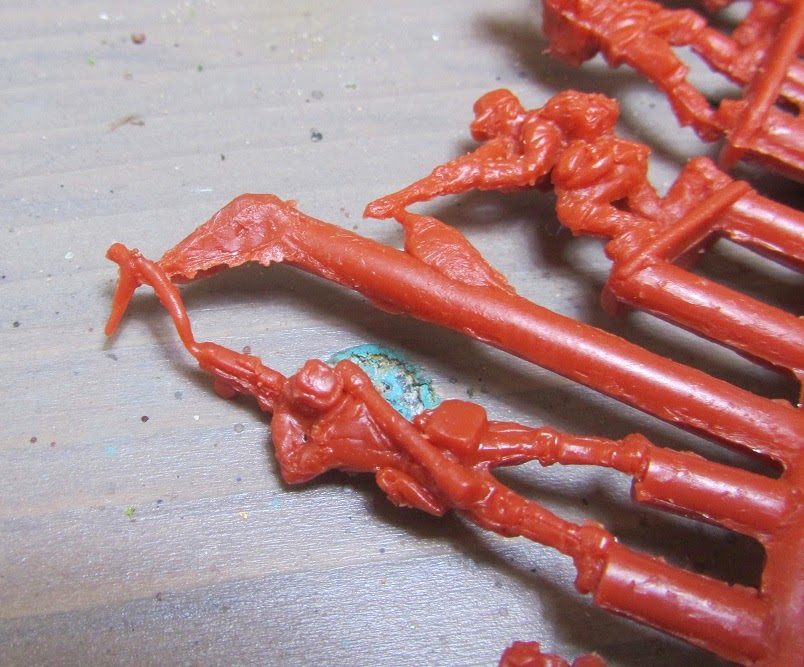
The box doesn't take much space and contains four of these sprues:


Each sprue has an officer with a pistol, two riflemen with panzerfausts, a Light Machinegun, three SMG's and six vanilla riflemen. You should get two boxes to field a full rifle platoon as there are too many SMG's in the mix in relation to the riflemen.

The plastic is soft and the casting is bad. It is as expected. I saw the master models from the Strelets site and they're not that bad, actually. The molds and the plastic clearly dont do the figures any favours. The worst offender is the LMG, all the sprues have the MG bent like this:


That machinegun has been fired A LOT!

The thing is, if you want to do summer uniformed Finns in 1/72, and my gaming group does as there are already suitable soviets painted up in that scale, there are pretty much just two options. These ones or the ones made by CP Models, and they're not that handsome either. If you know others, let me know. I think I'll have to mix the two to get a force I can game with. Good thing vehicles and guns are pretty much German hardware or stuff captured from the Soviets.

Here's a rifle squad painted up. I didn't spend too much effort on them as they're pretty mushy where it comes to detail:


In the end I'd say they look ok for wargaming. They look appropriate from a wargaming distance and shouldn't raise any eyebrows. Unless you take a closer look:

derp.

K-k-kill me!

Well, at least they paint up quickly. I'll aim for a platoon sized force with some supports so I can game some fighting by my countrymen in the Continuation War.


Thursday, March 26, 2015

Reinforcements for my 20mm WW2 Germans

Chain of Command is played using a typical infantry platoon plus a variety of support options to give the force some color. I haven't had many support options yet and I've been borrowing my opponent's Germans so far. This latest batch remedies that and gives my Heer rifle platoon some much needed help.

A radio operator to act as a forward observer, a panzerschreck for those late war engagements and a sniper which is quite handy in CoC.
Two MG34's with a drum magazine and a tripod mount. HMG's to add firepower to my force. Note that some of these weapon teams require additional riflemen, which I need to do more of if I field a lot of these at once.
A medical orderly and some walking wounded.
A Pak36 to keep enemy vehicles worried.
A Panzer IV, which starts to be a bit heavy for Chain of Command, but might see the field if there's an abundance of support points in a scenario.

I found a Dragon models halftrack in the bargain bin of a local toy store and grabbed it. In CoC it will be more useful as a machine gun nest than a transport but you never know.

Building the halftrack took quite a while as Dragon models are really detailed and valued by military modelers. Even the inside compartment was fully detailed even though it is really hard to see inside once the model is complete.


So there you have it, more meat in the grinder.

Friday, August 8, 2014

20mm WW2 German platoon complete

I now have 40 something infantry for my WW2 Germans from Plastic Soldier Company. I bought these to take part in WW2 games some of my friends play and now I have enough for a "platoon plus" sized game. Four squads of infantry including both moving a shooting versions of their machine guns, a truck, a Flak 88 and a Stug. Plenty enough to have fun with.


I'm glad I've managed to "complete" a couple of projects this summer. It means there's room for new ones! And yes, the word "complete" should always be in quotation marks as far as miniature projects go as you never know when you decide to expand! I know I want to add a few odds and ends to my krauts, even if the core is done.

Thursday, February 13, 2014

TooFatLardies' Chain of Command: First game and impressions

There's been some buzz on the net about Chain of Command lately. It's a "platoon plus" sized WW2 skirmish where each player typically controls a platoon of infantry along with a bit of support like a tank or weapon teams. The intro videos TooFatLardies have published showed an interesting spawnpoint based system and even though the game looked like there's a lot of randomness going on I bought the PDF to give it a go. I went to my friends' place where we set up an eastern front scenario and played it with three players learning the rules as we went on.

The game starts with a "patrol phase" where players alternate turns moving patrol markers on the table. These markers must form a continuous chain with max. 12 inch gaps and once the markers encounter enemy markers, they are locked 12 inches apart. This serves to draw the line of battle on the table and is a nice little metagame to try and get an edge over your opponent with. When all the markers are locked, they are used to deploy three or four "jump off points" on the table. Let's just call them spawnpoints because that's what they are. These spawnpoints are placed in cover outside enemy LOS and can be used to deploy units on the table during the game. The idea behind this is that they represent areas on the field where the platoon leader can send his units to without the enemy seeing them advance, giving the game a fog of war element and the players some tactical flexibility. It pays not to deploy all your troops at once but see how the situation develops and keep some reserves. The spawnpoints also serve as victory locations and their capture denies the enemy of their use. A bit quirky but works well in practice.

We played a very basic match with just two platoons (3 squads and a commander) of similar infantry facing each other. Additional support was minimal. The German side got an adjutant leader to the platoon and the Soviet side took a sniper team. The terrain was laid out to represent a village in some woods so there's plenty of cover and LOS obstacles around.

The opening setup

The core gameplay happens in "phases" which each player alternates taking. During these phases the phasing player rolls typically five dice and consults the pips. 1's allow him to activate small teams, 2's allow him to activate whole squads (which typically consist of a rifle section and a LMG team), 3's activate junior leaders (squad NCO's who have better flexibility in commanding the squad than what you get on a 2), and 4's activate senior leaders (typically the platoon HQ who can command all troops in his command range). The amount of 6's rolled indicate whether the next phase will alternate to the other player, whether you get a double turn, whether the turn will end or whether there will be a random event.

All rolled 5's increase the players' "chain of command dice" which is another special mechanic to activate special abilities. You accumulate pips on the die for each 5 rolled, and once you have six pips, you have one special ability to use. These abilities range from moving spawn points to interrupting the opponent's turn to springing ambushes. Having one of these points in use while still having some troops undeployed is a good way to keep your opponent on his toes.

The Soviets move fast to claim a German spawnpoint.

The Soviet player got a good start by rolling a double turn on his first roll. This means he rolled a double 6, and was allowed to take another turn after completing his first. This allowed him to deploy a squad of infantry on the table and move it to take one of the German spawn points before the Germans could deploy anything. I guess they really caught the Germans with their pants down! The Germans quickly deployed one of their squads to the nearest spawn point and moved to reclaim the lost one. If a turn ends when one of your spawn points is in enemy hands, it is a bad blow to force morale. Too bad the Soviets had time to deploy their squad on overwatch, and there was no other way to get to the spawn point but over open ground.

The Germans lurk behind the house as the squad leader tries to figure out what to do.
Reasoning there is no other way, the NCO split his squad and had the LMG section set up on the right side of the house pictured above to lay down covering fire and have the rifle section assault the Soviet position from the left. Too bad it was the LMG team which drew the Soviets' overwatch fire and the team sustained a casualty and enough shock to pin them.

The LMG is pinned.

The Rifle section advances on the Soviets.

Meanwhile on the Germans' right flank, the Soviets began deploying and moved to take a fence along the road in the middle of the table. This game them hard cover whereas the Germans advancing towards them from the woods had only light cover. A firefight started and the Germans were indeed racking up more casualties and shock. This prompted them to deploy their third and final squad to help the second one, and the increased firepower helped them pin the Soviet squad. This was not before the German squad lost their NCO though. The Soviets deployed their third squad in the center of the table and advanced towards the ruin near the center.

The Soviets take position behind the fence.

The Germans gain numerical superiority and whittle down the pinned Soviets
Meanwhile near the captured German spawnpoint, the Germans launched their attack. They could not stall any further because the third unengaged Soviet squad was one move away from coming to assist the ones who captured of the spawnpoint. The platoon adjutant commander came to the scene and after some verbal advice, the squad NCO attacked. The rifle section lobbed a grenade on the Soviets causing a casualty and a point of shock, and then charged. The result was messy. Since the Soviet squad had not been pinned, they were all too ready to receive the Germans and killed them all in a brutal round of rattling dice, losing only one man in return. The Squads' LMG was shot up by the center Soviet squad. The platoon adjutant found himself alone against two operational Soviet squads.

A grim result of the German charge.
On the other flank, the Germans got their only success of the day. The fresh..er German squad charged the pinned Soviet squad at the fence with much more success than their compatriots, routing those who would not die. When they tried to advance across the road to threaten the Soviet spawnpoints, they were caught in Soviet fire from the Squad at the center of the table and were pinned.

The platoon adjutant was captured in melee, and at that point the Soviet player used one Chain of Command point to end the turn, which crippled the German morale. Their morale had dropped steadily during the match because of losses and the spawnpoint was the final straw. A total defeat for the Germans.

Closing thoughs:

Chain of Command seems like a fresh contender to the platoon-sized ww2 ruleset race along with Bolt Action, Rate of Fire and the like. The game introduces mechanics I haven't seen elsewhere and the system works well. The rules are written in a way that might confuse the player a bit. There were several points where we were uncertain on how to interpret the rule, and the command system takes some getting used to. The book refers to Units, Squads, Sections and Teams with different rules, which can add to the confusion. The book says squads and sections are the same thing, but could they not have used just one of the terms since you already have to differentiate between units, squads and teams when doing activations?

The game can also be a bit random. The melee system seems to give a lot of dice for leaders in melee, making a lonely leader more than a match for four men attacking him. Rolling poorly on activations might leave you frustrated, but since each phase represents only a few seconds, having a squad unable to activate for two or three phases is ok realism-wise. People have complained that the game only lasts for a turn or two, but they're missing the point. The end of the turn means a "significant lull in the battle", which might not even happen in every match. It didn't in our game.

Apart from these gripes, the game works well. Movement and firing is easy and the suppression system works as it's supposed to. I'll need to play a couple more games to see if this is a keeper however.


Oh, and we played a game of Talisman too.

Wednesday, January 1, 2014

A bunch of 1/72 WW2 Germans

Here's the first batch of WW2 Germans I've completed. I planned to use these for the Rate of Fire demo game a year ago, but ended up borrowing the Germans used in the game save for the 88 which I did back then. Even that has been improved lately.

Here's a couple of photos of a squad of infantry. They're from Plastic Soldier Company and I rather like the detail on them. Some people complain that 1/72 or 20mm doesn't have enough detail, but I think there's plenty here. I plan to do a platoon or so of these. At least for starters.


Here's the Flak 88 I used as an objective in the demo game. I've added some dirt to make it look like something else than just a basecoated piece, and improved the paint job of the crew. The piece is from Zvezda.


Here's a Stug Ausf G assault gun from Revell. I wanted to use a grey paint job on the tanks to avoid painting camouflage. I want to have an airbrush for tank camo but I can't afford one right now. The paint job makes the model a bit anachronistic as the Ausf G came into service about the same time Germany changed into yellow camo in their tanks. At least that's what I think. Some treadhead might want to educate us if he spots this. As you can see, I used the opportunity to practice doing muddy tracks. Is it excessive?


Not wanting my troops to walk, I bought this Opel Blitz truck from Italeri. The understructure was a pain to assemble, but it was quick to paint. I go for the grey again to keep consistent.


Saturday, December 14, 2013

My own gaming weekend

Now that I live in a house of our own, it would be a shame to let that space go to waste. To avoid that, I hosted a weekend of gaming at my house. PaukarlahtiCon I called it. Perhaps calling the event a convention is a bit much but I had 15 people over, many of whom stayed throughout the weekend and I was happy I could accommodate them.

The main event was a 6 player game of Battlegroup Kursk. A few familiar faces and a couple of my regular opponents have been collecting WW2 in 1:72 scale for a while and they can pool together large battles now. I've been doing a little bit of 1:72, but contributed only a couple of terrain features, a  Stug assault gun and an Opel Blitz truck into this game. It was nice to attend a game which other people have worked hard on to realise for a change.

The scenario was set during the first soviet attack on Prokhorovka during the battle of Kursk. Our game organizer said the model ratio on the field was something around one model equals three tanks, so the scale was quite appropriate. Here's some pictures of the action with comments.

The table was 6 feet deep and 12 feet long. Three "standard" 6x4 tables side by side. On the bottom left you see the main Soviet tank assault. On the top left, you can see my portion of the forces. ordered to take the farm on the top right. Along the right table edge are German defenders. Infantry and guns fot the top half, mostly tanks on the bottom half. There is a German detachment in the farm in the center of the table.

German assault guns wait for Soviet attackers.

The Soviet T-34's with tank riders.
My forces (Some tank riders included, as well as a bunch of tanks in reserve)

Some German defenders facing my tanks.

The Soviet attack begins! The T-34's ride fast straight towards the German defenders and deploy infantry.


My Soviet forces advance similarly and lose a couple of tanks to enemy fire (German Marder II's in defense).

My tank riders bail out and swarm the enemy entrenchments.

At "the bottom", several Soviet tanks are destroyed and create an obstacle in the narrow pass between the farm and the table edge.

Lots of losses are taken but my forces reach the farm. It is not given without a fight though.

The advance is costly but the trench is taken as well.

In the center, Soviet reinforcements test the German lines but are destroyed by AT gun fire.

The situation at game end. The attack at the bottom of the field has halted at the center farm. On the top, my forces have cleared the farmstead and are poised to flank the German line. The Soviet losses have been unacceptaby high however, and the scenario is a clear win for the Germans.
Battlegroup Kursk seemed like a fun set of rules to play WW2 on this scale with. The rules for movement, firing and morale are easy to grasp and quick to play out. They reminded me a bit of Epic Armageddon actually. The rules for close assault felt a bit odd, however. Groups initiate and continue their close combats by spending order points, which is voluntary. This can lead to groups getting locked down in close combat for a long time if neither player spends points to continue it. Morale checks to enter close combat weren't modified by strenght ratio either, so 10 men assaulting a position held by one man would have the same chance of losing their nerve as against 20. I suppose it's just fog of war then, but it can lead to the player getting frustrated.

Also, I think tank battles feel a bit claustrophobic in 1/72 as the tanks start out what would be very close indeed for real world tanks. 

The "main hall" on saturday night.
Wings of Glory

I also got the chance to play a game of Battletech Quickstrike. I didn't break out the alphastrike rules as I hadn't print out the unit cards for it yet. The game was a straightforward take and hold affair and ended up in a clear defeat for my side. We agreed that the jump pack rules require some tweaking as light jump mechs are super fast enabling them to easily get behind enemy mechs. They are also difficult to hit because their to hit modifiers are affected by their maximum speed, not by how much they actually move.


The city looks a bit green. I think I'll have to get some grey or brown basing for city blocks.

The mechs engage in a close range firefight.


All in all, the weekend was a great success. I'll definitly host another one when I'll get the opportunity