Showing posts with label black powder. Show all posts

Wednesday, January 20, 2021

ACW Isolation Kriegspiel: Battle of Kernstown 1862

Time for another remote Kriegspiel, this time using Black Powder rules and on a lower level of command. Instead of the whole army the players commanded on the Volley & Bayonet Second Manassas game, they had a division each. The scenario I picked was the Battle of Kernstown scenario in the Black Powder second edition rulebook. Unlike last time, I'll keep the commentary brief this time, only offering a rough outline of the events. 

For background on the scenario, I suggest you read the wikipedia article on the First battle of Kernstown, but in a nutshell it was a division versus division affair where Thomas Jackson attacked a Union force which was much larger than he anticipated and got beaten back in a rare loss for him.

I drafted briefing documents for the players along with a historical map of the area. The players drafted their plans and away we went. I would update them on the situation every turn or two and send them updated maps with incomplete intelligence. 

Union briefing (PDF) 

Confederate briefing (PDF)


Briefing map given to the Confederate commander

Map given to the Union commander


Union troops taking position on the hill north of Kernstown
 

The Union commander set his forces up in a line centered on a hill north of Kernstown with one brigade in reserve. The Confederates started their day by scouting the Union positions with their cavalry, being generally successful in gaining intel, but not enough to realize their initial estimate of enemy strength was underestimated.

Confederate guns line up west of Kernstown

Infantry lines up for attack

The Confederates decided to push the Union center aggressively and take the hill. They massed their artillery in the center and sent their cavalry on the right to see if they can turn the enemy flank.


Confederate map after initial deployment. Due to blunders on scouting rolls on the right flank, the dismounted union cavalry brigade is seen as infantry pickets.


A Union cavalry brigade is mistaken for infantry pickets


The attack on the hill begins

The attack on the hill succeeds but only barely. The Confederates are pretty beat up, but manage to avoid breaking. The Union brigade holding the hill breaks and the Union commander has to relocate his HQ.

After an aggressive charge by the Stonewall brigade, the Union center breaks.


Union map after the Confederates take the hill.

The Union commander calls for reinforcements, but during this time his second brigade also breaks in the firefight. The Confederates have managed to take on two brigades in turn with a smaller force and concentrate fire well. Union cavalry moves to counter the Confederate cavalry flanking manoeuver, but neither cavalry commander commits to attack the other.

Union reinforcements arrive but decide to stay on defense rather than counterattack.


The confederates keep the hill, but are in no condition to fight.

In the end, both armies order their troops to defend and as the scenario clock is around 5 PM, I call the game. The Confederate division broke two Union brigades without having any of theirs break taking ground in the process so they win the day.

The Confederate success owed a lot to the Union commander being uncertain whether there were still forces forthcoming and thus didn't converge on the Confederate main attack. Also, he didn't know the attackers were close to the breaking point and so didn't opt to retake the hill. This is again a feature of a limited intelligence game. In a normal miniature game, the players would be a lot more decisive in their actions and immediately spot good opportunities.

In hindsight Black Powder wasn't the best set of rules for a game like this. The action progresses fast in Black Powder and I think kriegspiel is best played on a higher level of command. On the plus side, this was much easier to set up and run than the Manassas game.


Wednesday, April 27, 2016

5 year anniversary! Also, an overview on Black Powder: Glory, Hallelujah!

Look at that. It's been five years and a month since my first blog post! Somehow it feels like the past five years have gone by really fast but then I look at my first posts and it feels like my bull run project in the spring of 2011 was ages ago. The human perception of time sure is strange.

Well, since I started out with ACW stuff, might as well write you some today! Warlord Games has released an ACW sourcebook for Black Powder and I got my hands on a copy. It's called Glory, Hallelujah! and it's written by Dr David B James. Note that I won't take pictures of the contents, you can find the pages they've seen fit to publish over here.


First thing I notice is that the book is quite heavy. In fact, it has a page count of 180 pages, the same length as the Black Powder rulebook itself! I definitely expected something lighter. It's a softcover book with all the gloss and colourful pictures you expect from a Warlord Games publication. As you might guess, doing a page count like that on a supplement requires quite a bit of background fluff written into the volume. There is quite a thorough introduction to the various aspects of the American Civil War as a wargaming theatre which makes it a good "first ACW wargame" book for anyone not familiar with the period but for the grognards out there its mostly unnecessary padding. The "fluff" takes about 57 pages.

Yup, that's thick.

The additional/modified rules take about 22 pages of the book. Here's a rundown on what rules are included:

- Rules for terrain, especially different types of woods
- No squares or assault columns allowed
- Cavalry less effective in charges, better handling for dismounted cavalry
- Stat tweaks for artillery, range tweaks for all weapons.
- The role of skirmishers is to screen friendly infantry, not very effective when firing
- Passage of lines is possible but can lead to some units passing through, some not
- Moving fast and firing is not possible for infantry
- Smoothbore muskets have a close range bonus
- Breechloaders and carbines are more effective but may run low on ammo
- Units that break from shooting are "whipped" instead and remain on the table instead of being wiped out
- It is more difficult to order infantry to charge
- Generals may fight on foot and are less prone to getting shot. Generals on horseback are more vulnerable
- Snipers may be attached to regiments and make it easier to drop generals
- a section of rules for forts
- a section of rules for naval units

Nothing dramatic and overall the rules look like good tweaks to the basic rules to make them feel less like Napoleonics and more like ACW without sacrificing playability. It should definitely give players a common framework on which to build ACW games using Black Powder rules.  

Army lists, special units and characters take about 45 pages. Scenarios and battle reports take about 50 pages. The army lists contain rosters and points values to the opposing armies in different years of the war, but the rules on composition are quite light. Also the varying sizes of regiments during the war are passed with a bit of a shrug which was a bit disappointing. One of the things that doesn't "feel right" when gaming ACW with standard Black Powder rules is in how to represent the different sized regiments.

There are ten scenarios which are most welcome. There aren't many ready made Black Powder ACW scenarios around the net and frankly I'm a bit lazy to adapt scenarios from other sources. What I don't like about the scenarios is that like in for example the Hail Caesar rulebook they don't bother telling us the size of the table even though they're careful to specify some range restrictions in inches. I think it would be much clearer to just state "this scenario was originally played on a 6´x5´ table" or whatever so that the players wouldn't need to guess what size the table they playtested these on was.

In summary, it's a good supplement to Black Powder. It's not essential as the base rules work for ACW well enough but enough thought and work has gone into this book to justify its existence. It's a good buy especially to those who are hesitant to make up their own house rules and wish for something "official" to rally around. 

Wednesday, November 11, 2015

Black Powder ACW: Henry House Hill

I found a regimental level scenario (WSS 56) for the central engagement of the Battle of Bull Run: the attack of the Union army on Henry House hill, guarded by Thomas Jackson. The scenario was easy enough to adapt to Black Powder. I made the following adjustments to your average BP game:

- Since there were more than twenty regiments per player and only a short evening to play, all regiments are small without any special rules. All commanders have the same leadership value of 8.

- All the measurements are halved for 6mm scale play, and musketry range is reduced further to 9 inches as the small regiment is now "normal".

- Most orders are given as brigade orders for the whole brigade and we're a bit more flexible with what can be done with one order.

These mods led to much faster gameplay as there were no stats or special rules to check out, and the small regiments were easier to rout (which fits nicely with the amateur armies fighting this first battle of a long war). We finished the game in less than four hours, including setup.

I forgot my camera again but here are some pics from my cell phone that are not that bad:


The game looked quite nice with lots of regiments moving about. The Union army, plagued by poor command rolls advanced on the hill. The Confederate artillery was especially effective, breaking one Union brigade early on. A flanking attempt by the Union troops on the Confederate left was blocked by timely reinforcements. A long battleline was drawn and a heavy exchange of fire followed. The Confederates ended on the losing side this time around, falling to musketry fire while holding back the single charge the Union troops launched.

A bit dicey, the musketry duel that decided the battle, but it was still great fun!

Thursday, October 1, 2015

Black Powder ACW in 6mm: Gettysburg Herbst Woods

I started working in the city of Jyväskylä which means some time apart from my family every week, but also increased time for hobby stuff. It didn't take me long to find the first brave general to face me in the field of battle at the local FLGS.

The PM attacks at Gettysburg (wikipedia)

I looked for a small introductory-sized scenario for Black Powder and found one in Wargames, Soldiers and Strategy issue 66. In Gettysburg again, the scenario plays the afternoon attack of Pettigrew and Brockenborough across Willoughby run into Herbst woods and beyond. Against them, the Iron Brigade led by Meredith and Biddle's brigade. I didn't bring my camera so I just have a couple of photos taken with my cell phone.


It's a 4 foot by 3 foot table. We halved the default distances from Black Powder and it worked fine. It was a bit of a tight fit for the four brigades on the table, but worked ok for a tutorial.


Long story short: The Confederates crossed the stream and Biddle's brigade took position behind a long fence. A long firefight began, during which the Confederates unsuccessfully attempted to turn the Union left. Their musketry fared much better and shook the boys in blue pretty bad. Even though the Union troops returned in kind, they could not hold their line. Meredith's iron brigade was forced to vacate Herbst Woods and nearly half of the Union regiments had routed (versus just one of the Confederate regiments) by the time we called the game.

It was a good thing my opponent won, too so that I might have a shot at a rematch ;)

Thursday, October 10, 2013

6mm Black Powder ACW

Hi all,

Here's a report of the regimental level ACW game I hosted at Warcon using my 6mm collection. I'll also give you info on the scaling and the setup of things as I gather from the Google search traffic I'm getting on Hail Caesar that a lot of people are wondering on how to apply the Warlord Games rulesets to 6mm.

Scaling

Black Powder is a 28mm game and meant to be played on a huge table. The recommended depth of the table is something like five or six feet. The amount of figures needed in 28mm is something from 16-20 models per unit upwards and an army required by most of the sample scenarios would take hundreds of 28mm models. For someone with limited space and painting time this can be a dealbreaker.

As it happens, the game scales quite nicely to 6mm models when you simply halve all ranges. All the ranges used in the game are even numbers so there are no awkward half-inches to deal with. The effect on table space is not quite as drastic as with substituting inches with centimeters (as I've done with Hail Caesar). This makes the standard 6x4 foot wargames table the equivalent of a 12x8 foot table. Lots of elbow room.

The standard frontage of an infantry unit in unmodified scale is about 240mm to 300mm. In half scale the same range is 120mm to 150mm. My ACW infantry is based on 25mm wide (Fire and Fury) stands, and five of them gives me a nice looking unit 125mm wide and 50 models. For small units I use three stands just to keep the unit symmetric with the command stand in the middle. My artillery is based on 25mm stands too and I used two of them side by side for a battery of guns. Open order formations are simply represented by placing the stands one inch apart.


A Union brigade of  one standard unit, two small units and a leader.

The Scenario

I was determined not to return to Gettysburg for a while, but I spotted a nice and easy scenario in Wargames Illustrated 245. I needed a simple and straightforward scenario with simple terrain I could easily build in a convention 300 kilometers from my home. In WI245 there is a regimental Wheatfield scenario written by a David Brown for the Guns at Gettysburg rules (an ACW variant of General De Brigade). I adjusted the OOB to Black Powder and used the scenario map and the map from Maps of Gettysburg to do my version. The reinforcement schedule worked quite well as it was without tinkering with which turn the units would arrive.

In the scenario, three Union brigades defend the wheatfield and the adjacent hill against an attack by three larger, veteran Confederate brigades. The Union forces will receive plenty of reinforcements but will they arrive too late to keep the Wheatfield in Union hands?


The Game

We had four players participating in the game. Two had read the rules but no-one had played the game before. I had played Hail Caesar, which is quite similar, but this experience worked to my detriment a couple of times as a rule or a modifier would be subtly different and I would try and play the rule the wrong way. All the players had some experience from miniature wargames (and one was a fresh convert from the grim, dark future with no prior experience with historicals). I think we were pretty much at home with the ruleset by turn three so points to Black Powder for clarity and ease of learning!


One Union brigade was deployed on the Wheatfield in the center, one was protecting it's right flank on the hill and one was on Wheatfield lane ready to support the ones in the front. Two Union artillery batteries were also on the road.


The Confederates kicked off the game by marching on the table from the woods south of the Wheatfield. They had the veteran status but the Union forces facing them had a stone wall to take cover behind.


The reserve Union brigade saw an opportunity to threaten the Confederate left flank and marched on with great speed.


This forced the Confederates to deploy their reserve brigade to counter, and with a similarly good activation roll they now deployed into line withing musketry range of the Union brigade still in field column. Uh oh..


The volley of musketry caused some casualties in the Union column, and they hastily started to form line. One regiment was too disordered to comply, and had to remain in column. (Red markers are casualties, yellow markers are disorder)


At the Wheatfield the Confederates took their sweet time to reach the Union defenders (two consecutive failures in command checks, I think). When they charged, the Union forces protected by the stone wall had no trouble repulsing the attacker. On the Confederate right the skirmishers were pushed back but this was not enough to remedy the obvious blunder of charging headlong into a stone wall.


The hill objective received a charge as well. Freshly Raised troops versus Reliable veterans, so the result was clear? Nope, the Confederates were repulsed again.


To make things worse the Union forces took their opportunity to cut the Confederate line in two and capture their artillery while they were at it! The desperate Confederates on the right flank assumed a defensive posture.


On the Confederate left both parties were pretty beat up but the Confederates had failed to gain a breakthrough.


 Even on the far Confederate right the regiment had trouble brushing aside the skirmishers in front. The noose was tightening on the right flank as three isolated Confederate regiments were slowly being encircled.


As all of the Confederate attacks had failed and Union reinforcements were flooding to the field we decided to call the game. The utter failure of the attacks owed a bit to hasty scenario conversion and to my own tactical blunders. Design-wise, I think there wasn't an appreciable difference between veteran troops and the green troops they were facing. The "drama" of the scenario would have had the initial Union defenders running and the real fight would have been fought between the reinforcements and the worn out Confederates. To make this the probable outcome I'll need to tinker with the stats a bit. I think as far as tactics go, I shouldn't have attacked that wall head on but rather flank the position as I had room and time to do so.

The Black Powder rules felt nice and light. The troops were easy to maneuver and there were just a few modifiers to learn. I think the ruleset works best for a carefree saturday evening game where you don't want to stress out on the minutiae and just want to have a lot happen on the table with not much effort. I think I have to look at the skirmisher rules again though as one small skirmisher unit held a full close order regiment in melee for three turns I think. Was that just good luck for the boys in blue?

Anyway, it was a great evening and I had the pleasure to play with three gentlemen I haven't played with before, one of whom will hopefully be a new convert to historical wargames!

Tuesday, October 8, 2013

Warcon 2013

This year's Warcon (held in Tampere, Finland) was a treat as always. I managed to keep playing through the weekend with only minimal downtime and tried quite a few new wargames.

Sword of Rome

Sword of Rome is GMT's card driven strategy boardgame set in the Camillan period of Rome (I think). It puts the Romans, Gauls, Phoenicians, Samnites, Syracusans and Carthaginians on the board to solve their disputes with some dice rolling and maneouvering.

We played a four player game. I got the Gauls.

After some successful campaigning (looting the countryside that is) the Gauls threaten Rome herself. Brennus besieges Rome but is unable to make her surrender.
I neglect to protect my rear and the transalpine Gauls invade. The support of my home cities crumble and disaster is near.
With sage advice from an experienced player, I stab the Phoenicians in the back, claiming enough victories to resume control of my home territories.

In the end, the Phoenicians were totally wiped out and Rome was barely hanging on. After learning a valuable lesson on protecting my rear, I went on to grab a tiebreaker victory from the Greeks.


 Commands & Colors: Napoleonics

A quick filler game of C&C:N to finish friday. I don't remember the scenario but my brits and portuguese troops were soundly beaten.


Labyrinth: The War on Terror 2001 - ?

GMT's Successor to Twilight Struggle, Labyrinth is a card driven game where the United States attempts to stem the rising Islamist extremism in the Middle East and Europe.
I was a first timer playing versus someone who had played the game some times before, so I picked US because I thought it would be easier to play for the first time.

My opponent's opening play was to dump all terrorist cells in Afghanistan on the first round. He explained to me that the move was pretty much the best one could do in the game at this point. I responded by putting some boots on the ground and by overthrowing the Islamist regime.
My opponent then spread his cells to the neighboring Pakistan managing to overthrown the local government. I retaliated again by sending troops, but unfortunately not before the Islamists had helped themselves to the Pakistani nuclear arsenal!
The results were predictable. With a few moves I was unable to stop he moved his terrorist cells through Europe to the United States and blew up a nuke there. Game Over.
The game felt somewhat confusing and after the brief game I still don't have an idea on how to play or stop the terrorist infiltrators. I think I'll need a game or two more to wrap my head around the game.


Maria

Maria is Histogame's game set in the Austrian War of Succession in the 1700's. It is the successor of Friedrich and I have played it a few times now. It is one of the better three player wargames out there but not exactly balanced. Prussia wins often, France sometimes and Austria rarely. I was teaching the game to two new players so I naturally picked Austria.

After a traditional slugfest between Austria and France, the Austrians are left with little to pit against Frederick the Great.
The surprise comes from the French front, however as the Pragmatic army defeats the French and bring the game to a conclusion before the Prussians get a chance. This I've never seen before (although both Prussia and the Pragmatics are played by the same player)


Black Powder ACW

My first game of Black Powder and for me the main event of Warcon. We played the battle for the Wheatfield (Gettysburg) on a regimental level and fun was had by all. I'll write up a dedicated post on the game itself as it deserves it's own entry.


Epic Armageddon

My return to the grim darkness of the 41st millenium is in 6mm. A fellow gamer who has participated in some of my ACW games was happy to show me the ropes.

The Dark Angels and the Tyranids fight over a city on a not so grim and dark green planet.
The Marines capture a block while the Tyranids quicly capture most of the city.
*Scuttle Scuttle*
The buildings provide a good firebase

The tyranids charge the marine positions and reach melee range but are ultimately driven back.

The Marines take the city.

My opponent had put a bit more effort in his models than I had.


The game felt good and I decided then and there to expand my marines to a proper tournament sized army. I'm sure my opponent pulled some of his punches to spare the newbie so the next game won't be quite as easy.


Pax Baltica

I was interested to try this out. Another GMT game, Pax Baltica is a block wargame where two players play through the twilight era of Sweden as a great world power.

On the first turn the Swedes invade Estonia. This proves to be a mistake as the Russians are in range to counterattack and drinve them back into the sea.

Swedish armies are quick to raise but it takes time to get them across the Baltic sea. All invasion attempts are blocked.

The Russians can now spare some troops and invade my real life hometown in Finland.

The Swedish wise up and attempt a new invasion into the German territories, but Saxony has already gained too much strength and are more than a match for the Swedes.

The final battle ends with the Swedish king left alone on the field with one point as the attackers are forced to retreat. We call it a game at this point.

Either my opponent should have made a different opening play, we played the rules wrong or the rules are broken because it was next to impossible for the Swedes to gain a beachhead in the Baltics or in Germany. It's a fresh scenario though, not many GNW games around.


Commands & Colors: Ancients

I had just enough time left on Sunday to play a game of C&C:A. We played the battle of Marathon from the Greek expansion.

Opening setup. I got to play the Greeks.

With two consecutive "Order line" commands, I made simultaneous contact to the Persian line with all my troops.

The Persians line falters.

I add insult to injury with a card that allows me to hit with every unit adjacent to the enemy.

The Persian made a good comeback and only lost 6-5.

So, there it was, another thoroughly enjoyable con with lots of games to play. I'll end with some snaps from games I did not participate in.

Space Empires 4X
Red Winter
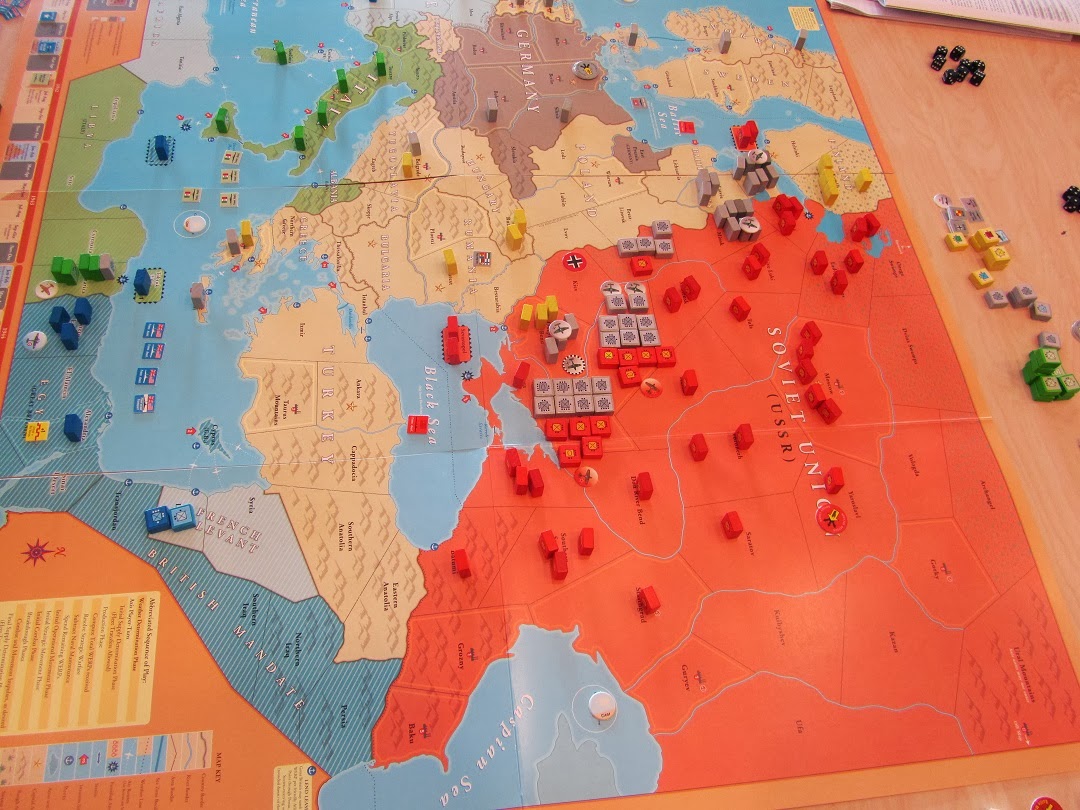
Europe Engulfed
Veli Veljeä Vastaan, a prototype wargame of the Finnish Civil War.
Manoeuvre.
Europe Engulfed, some 11 hours later.
Sword of Rome was really popular this year.
Nuklear Winter something something.